People
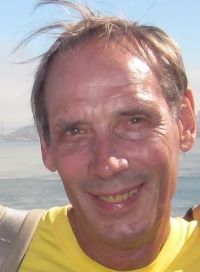
Obituary - Gavin Bell, daredevil correspondent and travel writer
Thursday 4 December 2025
Serenaded by Archbishop Desmond Tutu and offered personal protection by Palestinian leader Yasser Arafat, Gavin Bell was a daredevil foreign correspondent, travel writer and author of books on South Africa, Robert Louis Stevenson - and lower leagues football.
Gavin died at his home in Glasgow on November 28 at the age of 78, after a long and obstinate struggle with cancer.
After joining from AFP, Gavin worked for Reuters from 1975 to 1986, based in London, Beirut and Paris, then spent seven years at The Times as an arts correspondent in London and foreign correspondent in Delhi, Seoul and Johannesburg.
In a career spanning more than 60 years, he was the first non-French journalist to witness a nuclear explosion at Mururoa Atoll in the South Pacific.
He covered South Africa’s transition from apartheid to democracy, including the release of Nelson Mandela in 1990 after 27 years in prison.
He recalled going to interview Archbishop Desmond Tutu in Namibia and being greeted with a rendition of ''I belong to Glasgow'' in a broad Glaswegian accent. Bell’s mother accorded pride of place in her home to a picture of Tutu signed “Mrs. Bell, you’ve got a grand wee son.”
Covering the civil war in Lebanon for Reuters, he answered his door to find a masked gunman wielding a Kalashnikov assault rifle and bearing a personal offer from Arafat to provide personal protection. Bell refused and was later visited again to be told the offer had been withdrawn.
His first job as a journalist was as a sports reporter for his father’s news agency in Paisley, before becoming a reporter specialising in football and athletics for the Dundee Evening Telegraph, Sunday Post and Weekly News.
Friends remembered him as a trendy figure driving a BMW convertible, the roof usually open no matter what the weather.
Like his father a talented runner, he completed seven Marathons and prior to the opening of the Olympics in Seoul in 1988 he carried the Olympic Torch on one of the relay legs into the stadium. A copy of the Torch, featured on the BBC’s Antiques Road Show, remained one of his most treasured possessions.
Bell was a news reporter on the Daily Record in the late 60s and early 70s. From 1995-97 he was a senior features writer and columnist on The Herald, and from 1999-2001 chief features writer on The Scotsman.
For the past 24 years he had been a travel writer for, among others, the Daily Telegraph, Times and Sunday Times, Guardian, and Herald, and won awards from tourist boards in Canada, Sweden, Italy and the Caribbean.
He was the author of “In Search of Tusitala” (Samoan for writer of stories) about Robert Louis Stevenson's passage through the remote communities of French Polynesia, Hawaii, Kiribati and Samoa.
Former Reuters correspondent Fred Bridgland, who met Bell in South Africa when he worked for the Sunday Telegraph and The Scotsman, recalled: “Gavin described to me some of his fantastic experiences while researching this book: the sheer wonder of scuba diving in the South Pacific, of being carried by a powerful incoming tide between coral cliffs into Fiji’s Beqa Lagoon. Swept helplessly along by the currents, all around him were whales, bull, tiger and hammerhead sharks, giant manta rays, turtles, schools of barracuda and dense shoals of other fish.”
His fascination with football led to the writing of “Because it’s Saturday - A journey into football’s heartland,” a book about lower league clubs in England and Scotland and the parts they play in local communities.
A fervent supporter of Motherwell football club, when it reached the Scottish Cup final in 1991 he left the political drama in South Africa and, wearing his burgundy and gold scarf, flew back to watch his team beat Dundee United 4-3 at Hampden Park.
Motherwell players of yesteryear signed a team shirt presented to him a few weeks before he died at his home on the edge of a wood in Glasgow.
South Africa had a special place in his heart. It was where he met his wife Claire, who died in August this year, and where they latterly spent half of each year with their daughter Fintry. Visitors to the hospice where he spent time at the end of his life often found him writing essays to his daughter. His brother pre-deceased him.
He was a lover of music, especially classical and opera. In his last few months friends took him to concerts and shortly before his death he was still booking tickets several months ahead. ■
- « Previous
- Next »
- 54 of 624